Masters Thesis

As a gesture of good will to all those who attended the very first We Make Waves Mixcloud livestream, I am giving away my Masters Thesis for free.
The following DISSERTATION was submitted in May 2024 in partial fulfilment of the requirements for the degree of MASTER OF SCIENCE (MSc) in MAD STUDIES at QUEEN MARGARET UNIVERSITY, EDINBURGH.
ABSTRACT
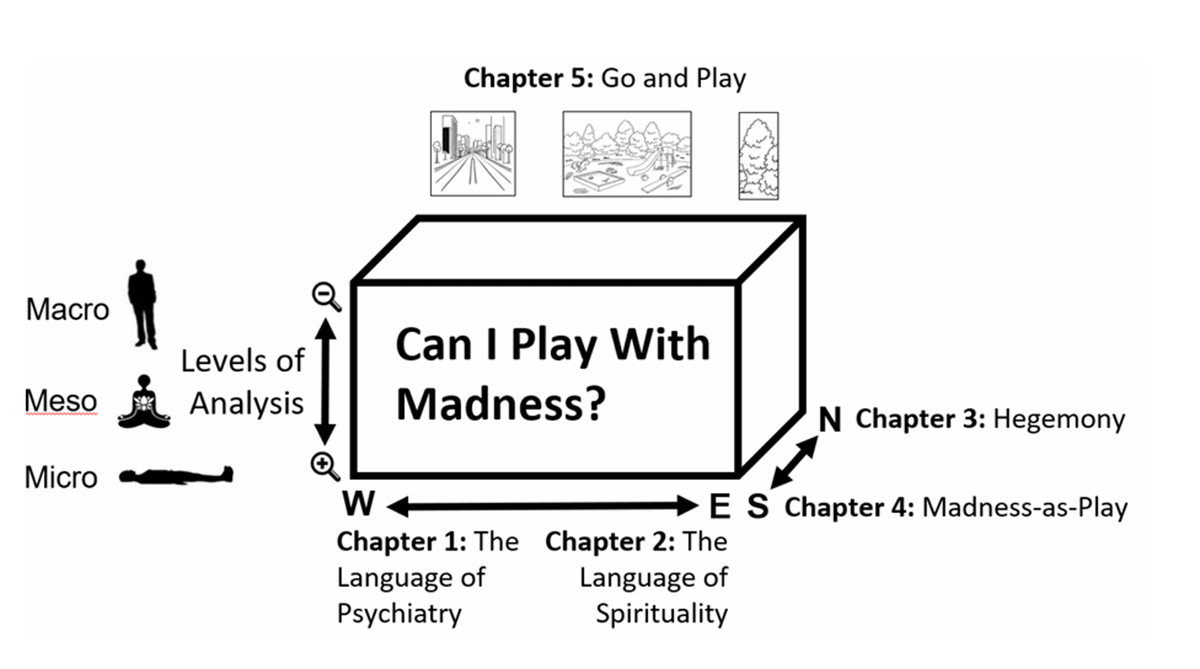
Inspired by a story of its impact on lived experience, the metacommunicative frame of play is explored as an alternative to the over-serious hegemonic discourse on madness. First, key theoretical assumptions are outlined in establishing the importance of discourse as ontology, which means that it shapes all phenomena, including madness. Second, an attempt at a descriptive statement regarding the nature of madness across cultures is made, suggesting it can best be understood as denoting a disruption in con-sensus. It is argued that Western discourse provides two main vocabularies of being for those who live through such disruptions: the language of psychiatry and the language of spirituality. In keeping with the spirit of play, the author draws on his own multi-dimensional pedagogical practice, to physically move the reader around the analysis of these discourses. This is metastructured, along the y axis, by a multi-level critical discourse analysis that considers the social practice of these languages at three levels of analysis which are connected to three physical positions: the macro standing up, the meso sitting down and the micro lying down. The reader is first, along the x axis, requested to move to the geographic West to explore the language of psychiatry at these three levels of analysis. Second to the East to explore the language of spirituality. Then, along the y axis, to the North to consider how together their shared over-seriousness constitutes a form of hermeneutic-ontologic injustice at each level. The reader then moves South to consider the metacommunicative frame of play as an antidote at each level: a dis-course of re-creation. Finally, the reader is asked to move outside the box, beyond the restrictions of their work space, to consider case studies that demonstrate the practical impact of the frame of play for madness across the three levels of analysis, first to the micro in the street, to the meso in the park, and to the macro up a tree. This returns the reader to the liberating interpretive activities that led to the story that initiated the research. A conclusion summarises the key lessons, emphasising that madness-as-play is a dis-course of re-creation that opens up intriguing possibilities.
Word Count: 12,099
For the complete PDF version click here.